EMT Practice Test

1. Question Content...


Question List

Question1: Please read this scenario prior to answering the question
Your role is that of a consultant to the Lead Enterprise Architect in a multinational automotive manufacturer.
The company has a corporate strategy that focuses on electrification of its portfolio, and it has invested heavily in a new shared car platform to use across all its brands. The company has four manufacturing facilities, one in North America, two in Europe, and one in Asia.
A challenge that the company is facing is to scale up the number of vehicles coming off the production line to meet customer demand, while maintaining quality. There are significant supply chain shortages for electronic components, which are impacting production. In response to this the company has taken on new suppliers and has also taken design and production of the battery pack in-house.
The company has a mature Enterprise Architecture practice. The TOGAF standard is used for developing the process and systems used to design, manufacture, and test the battery pack. The Chief Information Officer and the Chief Operating Officer co-sponsor the Enterprise Architecture program.
As part of putting the new battery pack into production, adjustments to the assembly processes need to be made. A pilot project has been completed at a single location. The Chief Engineer, sponsor of the activity, and the Architecture Board have approved the plan for implementation and migration at each plant.
Draft Architecture Contracts have been developed that detail the work needed to implement and deploy the new processes for each location. The company mixes internal teams with a few third-party contractors at the locations. The Chief Engineer has expressed concern that the deployment will not be consistent and of acceptable quality.
Refer to the scenario
The Lead Enterprise Architect has asked you to review the draft Architecture Contracts and recommend the best approach to address the Chief Engineer's concern.
Based on the TOGAF Standard, which of the following is the best answer?

Question2: Consider the following statements.
1. All processes, decision-making, and mechanisms used will be established so as to minimize or avoid potential conflicts of interest.
2. More effective strategic decision-making will be made by C-Level executives and business leaders.
3. All actions implemented and their decision support will be available for inspection by authorized organization and provider parties.
4. Digital Transformation and operations will be more effective and efficient.
Which statements highlight the value and necessity for Architecture Governance to be adopted within organizations?

Question3: Complete the following sentence:
Presenting different_________and_________to stakeholders helps architects to extract hidden agendas principles and requirements that could impact the final Target Architecture

Question4: Consider the following statements:
1. Each contracted party is required to act responsibly to the organization and its stakeholders.
2. All decisions taken, processes used, and their implementation will not be allowed to create unfair advantage to any one particular party.
3. Digital Transformation and operations will be more effective and efficient.
4. Strategic decision-making by C-Level executives and business leaders will be more effective.
Which statements highlight the value and necessity for Architecture Governance to be adopted within organizations?

Question5: Complete the sentence. The architecture domains that are considered by the TOGAF standard as subsets of an overall enterprise architecture are Business, Technology,

Question6: What is used to structure architectural information in an orderly way so that it can be processed to meet stakeholder needs?

Question7: Complete the sentence. When considering agile development, Architecture to Support Portfolio will identify what products the Enterprise needs, the boundary of the products, and what constraints a product owner has; this defines the Enterprise's

Question8: Which of the following is a responsibility of an Architecture Board?

Question9: Please read this scenario prior to answering the question
Your role is that of a senior architect, reporting to the Chief Enterprise Architect, at a medium-sized company with 400 employees. The nature of the business is such that the data and the information stored on the company systems is their major asset and is highly confidential.
The company employees travel extensively for work and must communicate over public infrastructure using message encryption, VPNs, and other standard safeguards. The company has invested in cybersecurity awareness training for all its staff. However, it is recognized that even with good education as well as system security, there is a dependency on third-parly suppliers of infrastructure and software.
The company uses the TOGAF standard as the method and guiding framework for its Enterprise Architecture (EA) practice. The CTO is the sponsor of the activity.
The Chief Security Officer (CSO) has noted an increase in ransomware (malicious software used in ransom demands) attacks on companies with a similar profile. The CSO recognizes that no matter how much is spent on education, and support, it is likely just a matter of time before the company suffers a significant attack that could completely lock them out of their information assets.
A risk assessment has been done and the company has sought cyber insurance that includes ransomware coverage. The quotation for this insurance is hugely expensive. The CTO has recently read a survey that stated that one in four organizations paying ransoms were still unable to recover their data, while nearly as many were able to recover the data without paying a ransom. The CTO has concluded that taking out cyber insurance in case they need to pay a ransom is not an option.
Refer to the scenario
You have been asked to describe the steps you would take to improve the resilience of the current architecture?
Based on the TOGAF standard which of the following is the best answer?

Question10: Please read this scenario prior to answering the question
You have been appointed as senior architect working for an autonomous driving technology development company. The mission of the company is to build an industry leading unified technology and software platform to support connected cars and autonomous driving.
The company uses the TOGAF Standard as the basis for its Enterprise Architecture (EA) framework.
Architecture development within the company follows the purpose-based EA Capability model as described in the TOGAF Series Guide: A Practitioners'Approach to Developing Enterprise Architecture Following the TOGAF ADM.
An architecture to support strategy has been completed defining a long-range Target Architecture with a roadmap spanning five years. This has identified the need for a portfolio of projects over the next twoyears.
The portfolio includes development of travel assistance systems using swarm data from vehicles on the road.
The current phase of architecture development is focused on the Business Architecture which needs to support the core travel assistance services that the company plans to provide. The core services will manage and process the swarm data generated by vehicles, paving the way for autonomous driving in the future.
The presentation and access to different variations of data that the company plans to offer through its platform poses an architecture challenge. The application portfolio needs to interact securely with various third-party cloud services, and V2X (Vehicle-to-Everything) service providers in many countries to be able to manage the data at scale. The security of V2X is a key concern for the stakeholders. Regulators have stated that the user's privacy be always protected, for example, so that the drivers' journey cannot be tracked or reconstructed by compiling data sent or received by the car.
Refer to the scenario
You have been asked to describe the risk and security considerations you would include in the current phase of the architecture development?
Based on the TOGAF standard which of the following is the best answer?

Question11: Which of the following describes a purpose of Architecture Principles?

Question12: What are the four architecture domains that the TOGAF standard deals with?

Question13: Consider the following statements
1 A whole corporation or a division of a corporation
2 A government agency or a single government department
3 Partnerships and alliances of businesses working together such as a consortium or supply chain What are those examples of according to the TOGAF Standard?

Question14: Which of the following statements about architecture partitioning are correct*?
1 Partitions are used to simplify the management of the Enterprise Architecture
2 Partitions are equivalent to architecture levels
3 Partitions enable different teams to work on different element of the architecture at the same time.
4 Partitions reflect the organization's structure

Question15: Consider the following statement:
According to the TOGAF Standard a governed approach of a particular deliverable will ensure a system of continuous monitoring to check integrity changes decision-making and audit of all architecture-related activities Which deliverable is being referred to?

Question16: Which of the following does the TOGAF standard describe as a package of functionality defined to meet business needs across an organization?

Question17: Which one of the following classes of information within the Architecture Repository would typically contain a list of the applications in use within the enterprise?

Question18: Refer to the table below:

Which ADM Phase does this describe?

Question19: Consider the following ADM phases objectives.
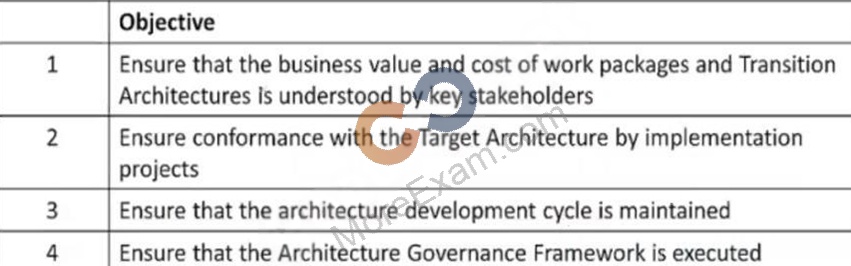
Objective
1-Determine whether an incremental approach is required, and if so identify Transition Architectures that will deliver continuous business value
2-Generate the initial complete version of the Architecture Roadmap, based upon the gap analysis and candidate Architecture Roadmap components from Phases B, C, and D
3-Finalize the Architecture Roadmap and the supporting Implementation and Migration Plan
4-Ensure that the business value and cost of work packages and Transition Architectures is understood by key stakeholders Which phase does each objective match?
Question20: According to the TOGAF standard, what term describes an individual with an interest in a system?

Question21: Please read this scenario prior to answering the question
You are serving as the Lead Architect for an Enterprise Architecture team within a leading multinational biotechnology company. The company works in three major industries, including healthcare, crop production, and agriculture. Your team works within the healthcare division.
The healthcare division is developing a new vaccine, and has to demonstrate its effectiveness and safety in a set of clinical trials that satisfy the regulatory requirements of the relevant health authorities. The clinical trials are undertaken by its research laboratories at multiple facilities worldwide. In addition to internal research and development activities, the healthcare division is also involved in publicly funded collaborative research projects with industrial and academic partners.
The Enterprise Architecture team has been engaged in an architecture project to develop a secure system that will allow the healthcare researchers to share information more easily about their clinical trials, and work more collaboratively across the organization and also with its partners. This system will also connect with external partners.
The Enterprise Architecture team uses the TOGAF ADM with extensions required to support healthcare manufacturing practices and laboratory practices. Due to the highly sensitive nature of the information that is managed, special care has been taken to ensure that each architecture domain considers the security and privacy issues that are relevant.
The Vice President for Worldwide Clinical Research is the sponsor of the Enterprise Architecture activity. She has stated that disruptions must be minimized for the clinical trials, and that the rollout must be undertaken incrementally.
Refer to the scenario
You have been asked to recommend the approach to identify the work packages for an incremental rollout meeting the requirements.
Based on the TOGAF standard which of the following is the best answer?

Question22: Consider the following ADM phases objectives.
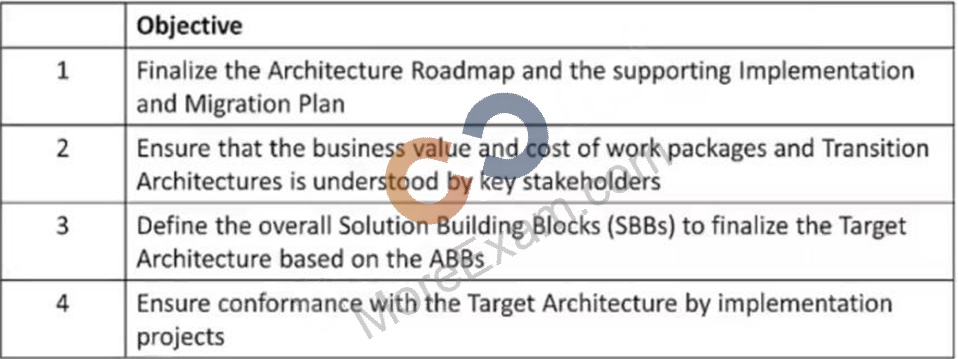
Which phase does each objective match?
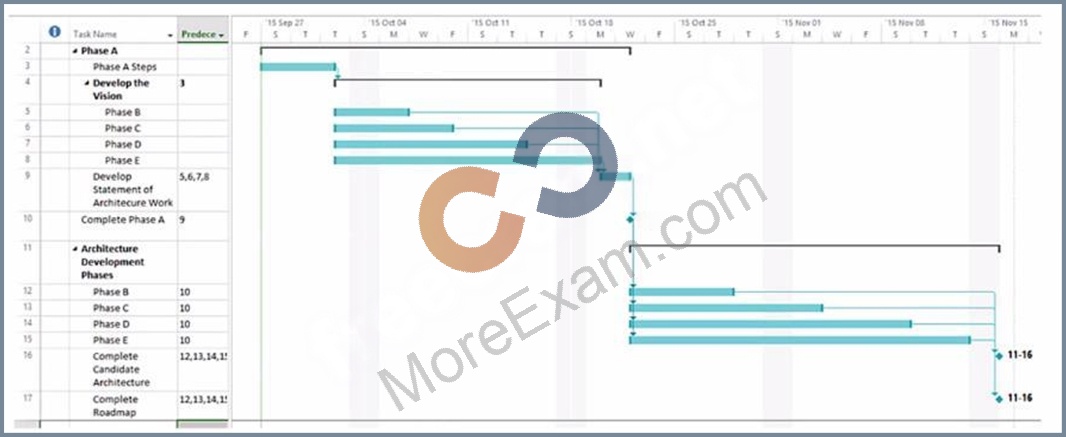
Question23: What can architects present to stakeholders to extract hidden agendas, principles, and requirements that could impact the final Target Architecture?

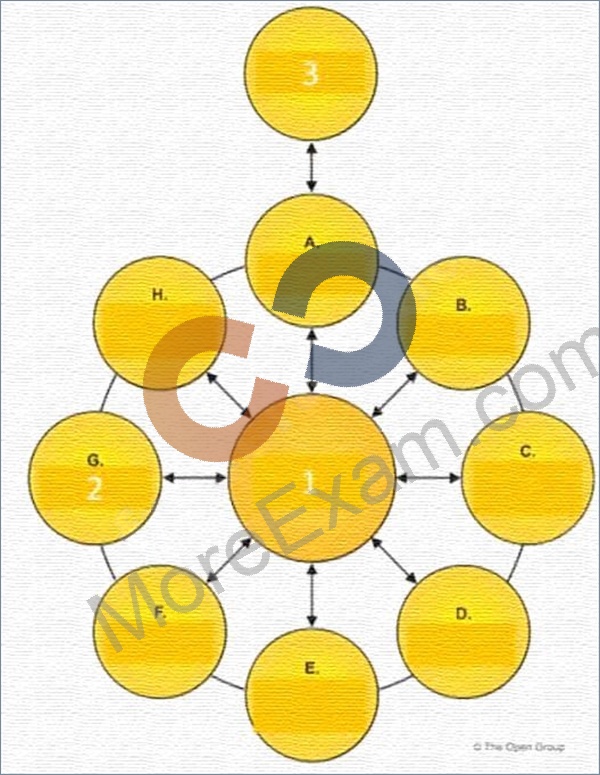
Question24: Exhibit

Consider the illustration showing an architecture development cycle Which description matches the phase of the ADM labeled as item 1?

Question25: Which of the following best describes the purpose of the Architecture Roadmap?

Question26: What are the four dimensions used to scope an architecture?

Question27: Which of the following is included as part of Architecture Governance1?

Question28: Complete the following sentence. In the ADM documents which are under development and have not undergone any formal review and approval process are_______________.

Question29: Consider the following ADM phases objectives.
Objective:
1.Develop the Target Data Architecture that enables the Business Architecture and the Architecture Vision
2.Develop the Target Business Architecture that describes how the enterprise needs to operate to achieve the business goals
3.Develop a high-level aspirational vision of the capabilities and business value to be delivered as a result of the proposed Enterprise Architecture
4.Identify candidate Architecture Roadmap components based upon gaps between the Baseline and Target Technology Architectures Which phase does each objective match?

Question30: Consider the following ADM phases objectives.

Which phase does each objective match?

Question31: Consider the following statement.
Projects may cycle between ADM phases, in planned cycles covering multiple phases.
What does it illustrate?

Question32: Consider the following chart:

Which important concept for Enterprise Architecture Practitioners does it illustrate?

Question33: Exhibit

Consider the illustration showing an architecture development cycle Which description matches the phase of the ADM labeled as item 2?

Question34: Consider the following statements:
1. Groups of countries, governments, or governmental organizations (such as militaries) working together to create common or shareable deliverables or infrastructures
2. Partnerships and alliances of businesses working together, such as a consortium or supply chain What are those examples of according to the TOGAF Standard?

Question35: What are the following activities part of?
* Initial risk assessment
* Risk mitigation and residual risk assessment
* Risk monitoring

Question36: Which of the following supports the need to govern Enterprise Architecture?

Question37: Which section of the TOGAF template for Architecture Principles should highlight the business benefits of adhering to the principle?

Question38: What should be put in place through organization structures, roles, responsibilities, skills and processes to carry out architectural activity effectively?

Question39: Complete the sentence Business Transformation Readiness Assessment is_________________.
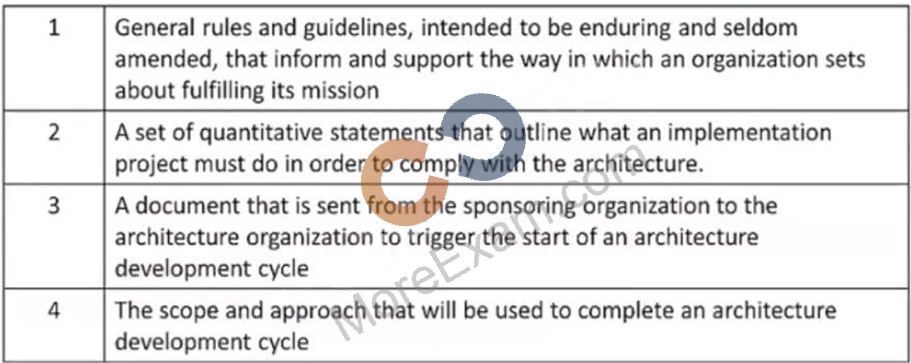
Question40: Consider the following descriptions of deliverables consumed and produced across the TOGAF ADM cycle.

Which deliverables match these descriptions?

Question41: What provides context for architecture work, by describing the needs and ways of working employed by the enterprise?

Question42: Which of the following best describes the purpose of the Architecture Requirements Specification?

Question43: Consider the following ADM phases objectives.
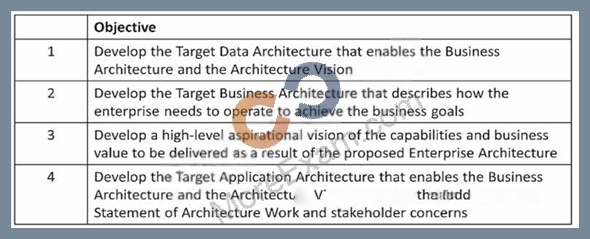
Which phase does each objective match?

Question44: Which of the following is the ability to develop use and sustain the architecture of a particular enterprise using architecture to govern change?

Question45: What component of the Architecture Repository represents architecture requirements agreed with the Architecture Board?

Question46: Which of the following best describes a purpose of the Gap Analysis technique?

Question47: Refer to the table below:
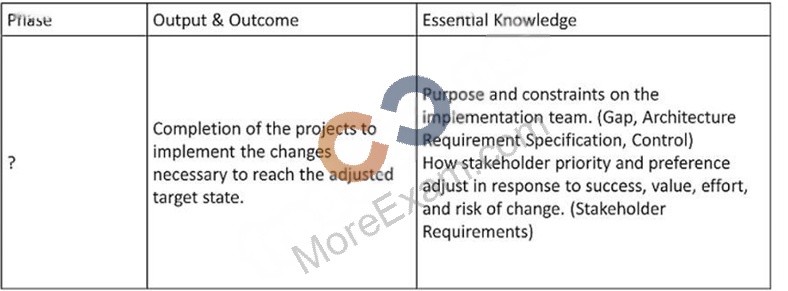
Which ADM Phase does this describe?

Question48: Consider the following statement:
Separate projects may operate their own ADM cycles concurrently, with relationships between the different projects What does it illustrate?

Question49: Which of the following best describes the purpose of the Gap Analysis technique?

Question50: Please read this scenario prior to answering the question
You are the Lead Enterprise Architect at a major agribusiness company. The company's main annual harvest is lentils, a highly valued food grown worldwide. The lentil parasite, broomrape, has been an increasing concern for many years and is now becoming resistant to chemical controls. In addition, changes in climate favor the propagation and growth of the parasite. As a result, the parasite cannot realistically be exterminated, and it has become pandemic, with lentil yields falling globally.
The CEO appreciates the seriousness of the situation and has set out a change in direction that is effectively a new business for the company. There are opportunities for new products, and new markets. The company will use the fields for another harvest and will cease to process third-party lentils. Thus, the target market will change, and the end-products will be different and more varied. This is a major decision and the CEO has stated a desire to repurpose rather than replace so as to manage the risks and limit the costs.
The company has a mature Enterprise Architecture practice based in its headquarters and uses the TOGAF standard as the method and guiding framework. The practice has an established Architecture Capability, and uses iteration for architecture development. The CIO is the sponsor of the activity.
The CIO has assigned the Enterprise Architecture team to this activity. At this stage there is no shared vision, or requirements.
Refer to the scenario
You have been asked to propose the best approach for architecture development to realize the CEO's change in direction for the company.
Based on the TOGAF standard which of the following is the best answer?

Question51: What is an objective of the ADM Preliminary Phase?